
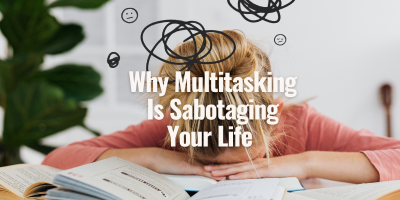
We live in a world that celebrates busyness.
Answer the email while attending the meeting.
Cook dinner while scrolling social media.
Listen to your partner while replying to a text.
Work while checking notifications every few minutes.
Somewhere along the way, multitasking became a symbol of productivity.
But neuroscience tells a very different story.
The truth is this: multitasking is largely an illusion.
Your brain cannot fully focus on two complex tasks at the same time. What we call multitasking is actually rapid task-switching—your attention constantly jumping from one activity to another. Every time you switch, your brain pays a price.
Researchers have found that frequent task-switching creates what is known as “attention residue.” Part of your mind remains stuck on the previous task while you attempt to engage in the next one. Instead of giving your full attention to the present moment, you bring fragments of unfinished thoughts with you everywhere you go.
The result?
You become mentally exhausted.
You make more mistakes.
You take longer to complete tasks.
And you feel increasingly overwhelmed.
Ironically, the very strategy many people use to get more done often causes them to accomplish less.
Dr. Gloria Mark, a leading researcher on attention, has shown that interruptions and constant switching increase stress and make it harder to sustain focus. Studies have also found that heavy multitaskers tend to perform worse on tasks requiring concentration, working memory, and filtering out distractions.
In other words, multitasking is not training your brain to become more efficient. It is training your brain to become more distracted.
Think about your daily life.
Have you ever been physically present with someone while mentally elsewhere? Be honest.
Maybe you were checking emails while your child was telling you about their day.
Perhaps you were half-listening to your spouse while scrolling your phone.
Or maybe you found yourself working on several projects at once, only to end the day feeling busy but strangely unaccomplished.
When our attention becomes fragmented, our relationships suffer too.
People can sense when they are receiving only a fraction of us.
Children notice.
Partners notice.
Friends notice.
Even coworkers notice.
Undivided attention is one of the greatest gifts we can offer another human being.
So what is the alternative?
Do one thing at a time.
When you work, work.
When you eat, eat.
When you listen, truly listen.
When you rest, actually rest.
Commit yourself fully to the task, conversation, or experience in front of you.
You may initially feel uncomfortable. Many people have become so accustomed to constant stimulation that stillness feels unfamiliar. Yet with practice, something remarkable happens.
Your focus improves.
Your productivity increases.
Your stress decreases.
Your relationships deepen.
You begin completing tasks faster and to a higher standard because your mind is no longer divided.
You stop merely surviving your days and start experiencing them.
The goal is not to do more.
The goal is to be fully present in what matters most.
Because a life lived in fragments is rarely a life fully lived.