
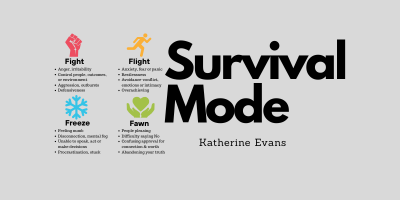
High-Achieving and Still Not at Peace? It’s Not You. It’s Survival Mode.
You’ve read the books. Attended the workshops. You’ve pushed yourself to succeed, lead, and show up fully—whether in business, education, or personal growth. On paper, you’re doing all the right things.
So why do you still feel… off?
The racing thoughts. The tension in your body. The inability to relax, even when you’re supposed to. The chronic self-doubt, anxiety, people-pleasing, or pressure to “get it perfect.”
This isn’t a flaw in your mindset.
It’s not that you’re lazy, broken, or weak.
It’s that you’ve been living in survival mode—and chances are, you didn’t even know it.
What Is Survival Mode?
Survival mode is not just a metaphor—it’s a real, measurable nervous system state. When your brain perceives a threat (emotional or physical), it activates a primal response: fight, flight, freeze, or fawn.
But here’s the thing:
You can live in a chronically activated survival state long after the actual threat is gone.
For many women, that threat wasn’t a war zone or one major trauma. It was constant emotional invalidation, lack of safety in childhood, or growing up with the message that love and approval were earned by being good, quiet, smart, pleasing, or perfect.
“Most of us aren’t living in fight-or-flight because of a single big trauma. We’re stuck there because of subtle, repeated messages from early life.”
— Dr. Gabor Maté, The Myth of Normal
The Early Programming That Shapes Us
By age 7, your unconscious mind has already absorbed your core beliefs about:
- Who you must be to be loved
- What’s required to feel safe
- Whether your emotions are welcome or a threat
- How much space you’re allowed to take up
If you learned that your needs didn’t matter, that love was conditional, or that safety came from performance, your nervous system got wired accordingly. These programs run silently, beneath the surface of even your most conscious goals.
You might be operating like this today:
- Saying “yes” when you want to say “no”
- Overachieving to avoid feeling “not enough”
- Seeking external validation before trusting yourself
- Staying in roles or relationships that drain you
- Making fear-based decisions (scarcity, avoidance, control)
The Illusion of Control: When Hustle Is a Trauma Response
For high-achieving women, the mask of competence can become its own trap.
We’re taught that productivity is power, that burnout is noble, and that needing rest or help means we’re failing. But in truth, this constant drive to succeed is often an unconscious attempt to outrun our programming.
“We cannot regulate what we cannot feel. We cannot heal what we don’t acknowledge.”
— Deb Dana, Clinical Social Worker & Polyvagal Expert
Living in survival mode disconnects you from your body, your intuition, and your joy. It keeps you reactive, tense, and externally focused—even when you appear composed on the outside.
The Awakening: You Don’t Have to Live This Way
This article isn’t about blame. It’s about awareness.
Once you realize that your patterns were never about willpower or worthiness—but about your nervous system doing its best to protect you—you unlock the door to real change.
This is where the work begins:
- Unwinding perfectionism that was once your safety strategy
- Releasing anxiety not through force, but nervous system repair
- Learning to feel safe in your own power, voice, and truth
- Stepping out of survival, and into embodied leadership
The transformation doesn’t come from doing more.
It comes from healing the part of you that believes you have to.
A Few Final Things to Consider
If any part of this feels uncomfortably familiar—good. That’s the awakening. The unraveling. The beginning of something new.
Your power was never truly lost. It’s been waiting underneath the survival patterns.
And it’s time to remember how to hold it.
If you’re ready to stop managing symptoms and start reclaiming yourself from the inside out, I invite you to explore my Power Programs — where we help women finally stop surviving and start living with calm, clarity, and confidence.